Contents
Prediction
What is the nature of your dependent variable (the variable you want to predict) ? Continuous - OR - Binary - OR - Ordered Categorical - OR - Categorical More Information (if yo...
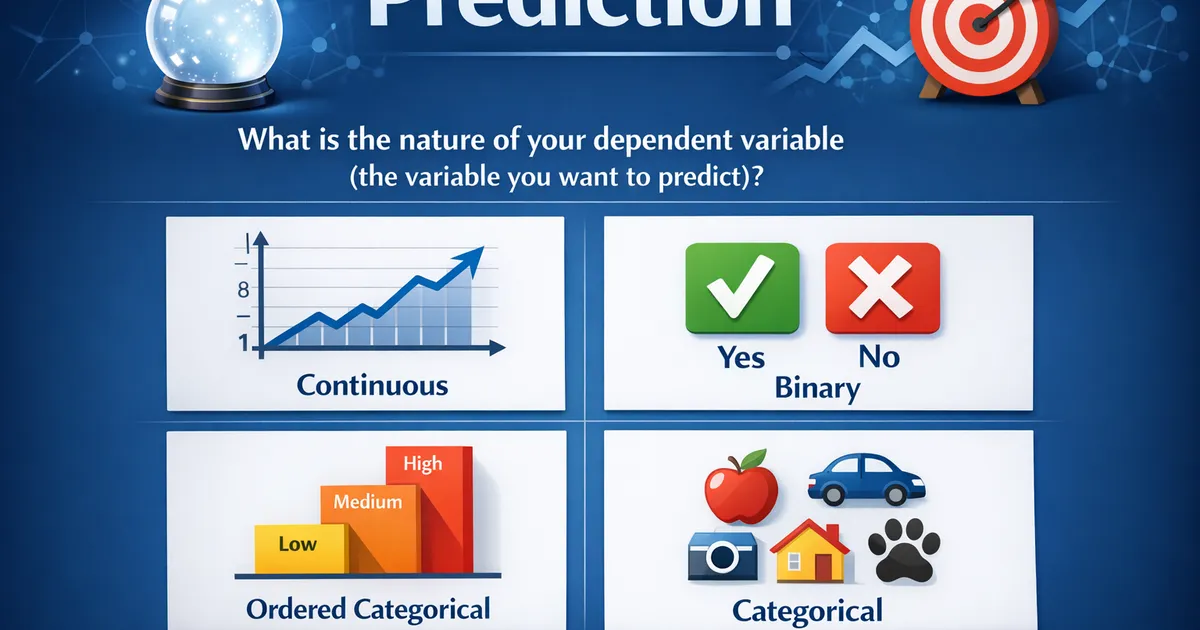
What is the nature of your dependent variable (the variable you want to predict)?
- OR -
- OR -
- OR -
- OR -
Count (events, incidents, rates)
More Information (if you need help deciding)
What is the nature of your dependent variable (the variable you want to predict)?
Continuous: A continuous variable is a variable that can reasonably take on any value within a range. Good examples of continuous variables include height, weight, exam scores, income, salary, etc.
Binary: Binary means that your variable is a category with only two possible values. Some good examples of binary variables include gender (male/female) or any True/False or Yes/No variable.
Ordered Categorical: An ordinal variable is one with categories that have an inherent order. For instance, education level (GDE/Bachelors/Masters/PhD), income level (if grouped into high/medium/low) etc.
Categorical: A categorical variable is simply one with categories (in this case not ordered). Examples of categorical variables are eye color, city of residence, type of dog, etc.
Count: A count variable is a non-negative integer representing how many times an event occurred. Examples include number of support tickets per user, number of purchases per month, number of app crashes per session, or number of errors per deployment. Count data requires specialized models (Poisson or Negative Binomial) rather than standard linear regression.